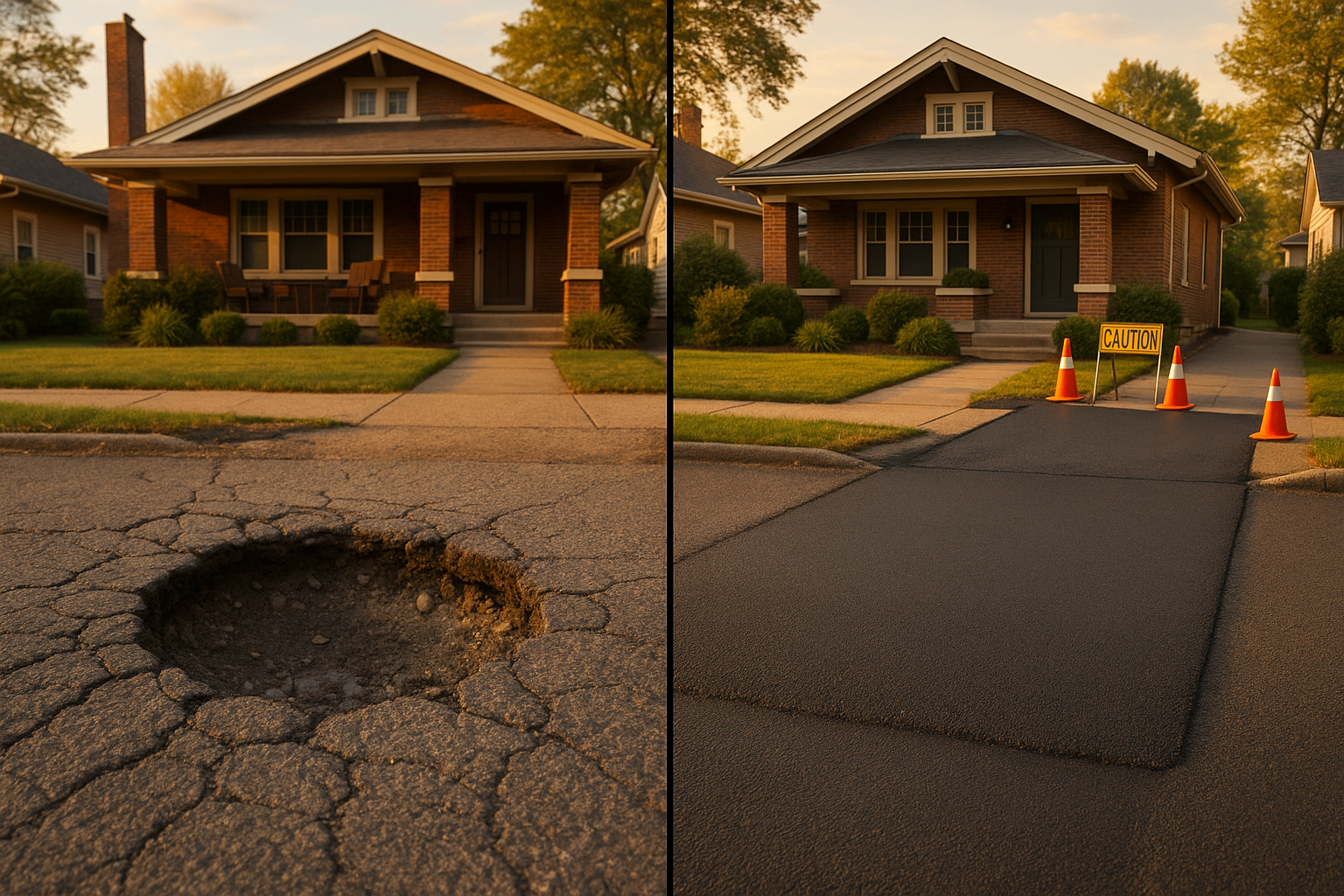
I was sitting in my living room last winter when I heard that awful crunch. You know the one—the sound of a car tire dropping into a hole you didn't see. My neighbor's sedan had found the pothole in our shared driveway. Again. He came over later, coffee in hand, and said, 'Can we just fix this thing so it stays fixed?'
That’s the question we get all the time from homeowners in Indianapolis, Carmel, Fishers, and everywhere around here. And the short answer? Yes. But it matters how you fix it. A bag of cold patch from the hardware store might last a few weeks. A proper hot-mix repair with the right base work? That’ll survive Indiana winters. We’re PavementPros, and we’ve seen just about every kind of pavement failure the freeze-thaw cycles around here can dish out.
What Actually Causes Potholes Around Indianapolis
It’s not just one thing. The biggest culprit is water. Water seeps into tiny cracks, freezes (we get a lot of that), expands, and pops the asphalt apart. Then a snowplow blade catches the edge on a driveway in Meridian-Kessler or a parking lot in Broad Ripple, and suddenly you’ve got a crater. Clay-heavy soil—common all over Central Indiana—makes it worse. When saturated, it pumps up under traffic and undermines the base. If the base fails, no surface patch will hold.
Other repeat offenders? Downspouts that dump right onto the driveway. Shaded areas that never dry out. Tree roots heaving near the curb line. In neighborhoods like Irvington or Greenwood, we see the same spots come back year after year because the drainage was never addressed. So our first step isn’t just to fill the hole. It’s to figure out why it formed.
Not All Patches Are Equal
We don’t believe in one-size-fits-all. There are three main ways we handle pothole repair in Indianapolis, and which one we pick depends on what’s going on under the surface.
Cold patch: Think of it as a band-aid. It’s a temporary fix for winter emergencies when hot-mix plants are closed. If you’ve got a hole that’s dangerous and it’s February, we can pack in a polymer-modified cold patch to get you through until spring. Just know it won’t last like a permanent repair.
Hot-mix saw-cut remove-and-replace: This is our go-to for structural failures. We cut out a clean rectangle (no weird shapes that telegraph through), dig out the bad base, add compacted stone if needed, and fill with DOT-spec hot asphalt. Every vertical face gets a tack coat so the new material bonds. The result is a patch that can handle heavy vehicles once it fully cools—usually the next day. For a commercial parking lot pothole repair in Indianapolis, this is almost always the answer.
Infrared asphalt repair: Seamless and fast. An infrared heater warms the existing asphalt around the defect, we rake in fresh mix, and compact it. The repair blends almost invisibly. Great for shallow surface failures in residential driveways where you don’t want a patchwork look. If your driveway in Carmel has a dozen small divots from plows, infrared can blend them without leaving a bunch of square scars.
We’ll talk through the options and give you a line-item quote that spells out exactly what we’re doing. No vague allowances.
How We Work (And What You Can Expect)
Nobody likes surprises when a contractor shows up. Here’s what happens when you call us for pothole repair in Indianapolis:
- Quick site visit. We come look at the damage, check drainage, and note any tree roots or sub-base issues. Usually same week.
- Written quote. You get a breakdown: areas to patch, method, materials, and any traffic control needed. For small driveway patches, the price often surprises people—it’s less than you think. No minimum charge games.
- Weather-smart scheduling. Spring through fall, hot-mix is always ready. In winter, we can do emergency cold patches or schedule you for the first warm stretch. If rain hits on the scheduled day, we reschedule; hot asphalt and standing water don’t mix.
- The work. Saw-cutting, excavation, compaction in lifts, tack coats, fresh mix. We square the edges, seal the seams, and clean up every scrap. Cones and signage go up for safety. For a typical residential driveway patch, light vehicles can roll over it in a few hours; heavy ones should wait overnight.
- Aftercare advice. We’ll tell you when to sealcoat (usually after a few months) and if crack sealing around the patch seams makes sense. Sealing those seams early can double the life of the repair.
And yes, we warranty our permanent patches. Cold-patch jobs are excluded because, well, they’re temporary by nature. We’ll always be upfront about that.
Local Service That Actually Covers Your Neighborhood
We’re based in Indianapolis, but we run calls all over the metro: Carmel, Fishers, Westfield, Zionsville, Brownsburg, Avon, Greenwood, Lawrence, you name it. If you’re in Marion County or the doughnut counties, we’re probably already working a job near you. The beauty of being local? We know the quirks. Like how the curb-line apron at the end of a driveway in Noblesville might need coordination with the city if it’s in the right-of-way. Most private driveway repairs don’t need permits, but we’ll help you figure that out.
We also handle small parking lots for HOAs, churches, and retail spots—places that don’t need a huge paving crew but do need professional asphalt repair. For those, we often recommend a mix of infrared for minor surface issues and cut-and-patch for the bad ones. Keeps the lot open and the customers happy.
Quick Answers to Common Questions
What’s the difference between cold patch, hot-mix, and infrared?
Cold patch is a sack of asphalt-like material you tamp into a hole—temporary and manual. Hot-mix involves removing the bad area, prepping a solid base, and pouring real hot asphalt that hardens into a permanent fix. Infrared reheats the existing pavement so new material bonds molecularly, leaving almost no visible seam.
How soon can I drive on a fresh patch?
For hot-mix, light vehicles can usually drive on it after a couple hours of cooling. Heavy trucks or heavy traffic should wait until the next day. Infrared repairs are ready in about 30 minutes.
Do you work in winter?
We can do emergency cold patches when it’s cold, but permanent repairs wait for warmer weather (typically above 50°F and dry). We’ll set a spring appointment and patch temporarily if needed.
Will the color match?
Fresh asphalt is always darker, but over a few months it weathers to match. Infrared blends better from day one. We choose aggregate that’s close to your existing pavement.
What if it rains on the scheduled day?
We reschedule. Hot asphalt and water don’t play nice. We’ll find the next dry window.
Got a hole that’s driving you crazy? Let’s get an honest assessment and a fair quote. No pressure, just a straight answer and a solid fix.
Ready for a free lot assessment?
We walk the lot, photograph the problems, and hand you a written plan — no pressure, no obligation.