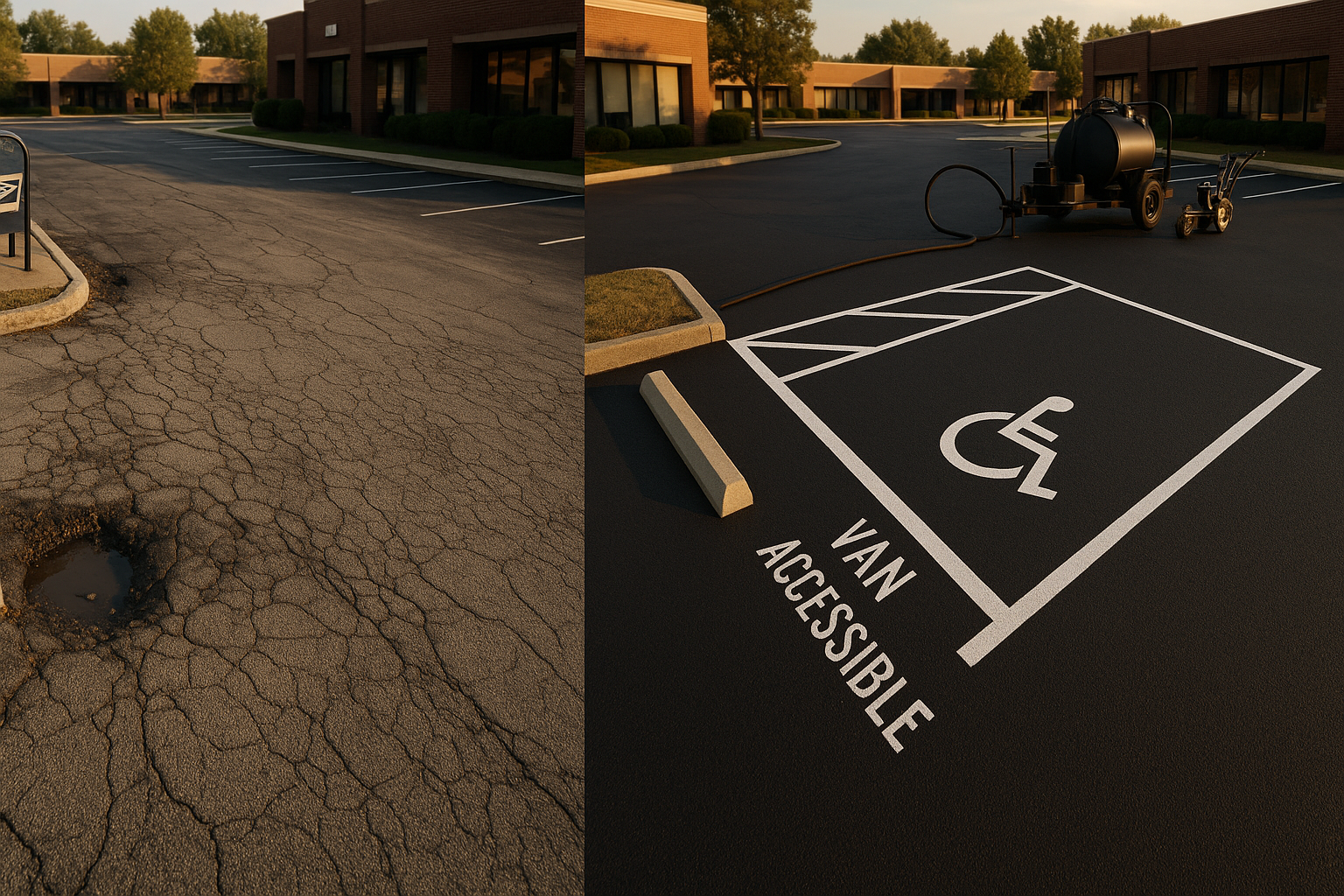
Last spring I got a call from a guy in Carmel—his office building’s lot looked like a relief map of the moon. Water got into tiny cracks over winter, froze and thawed about a dozen times, and by March he had potholes big enough to swallow a mailbox. He’d ignored a $2,000 crack-sealing quote the fall before… and now he was staring at an $18,000 resurfacing bill. That’s not dramatic—that’s just Indy pavement math. If you own or manage a commercial property around Indianapolis, you know that parking lot maintenance isn’t a “someday” thing. It’s a now thing. And the cost question is always the first one. So let’s talk real numbers, real problems, and how to not get burned.
What’s Actually in a Parking Lot Maintenance Plan?
A real maintenance plan isn’t a hit-and-run sealcoat job. It’s a full cycle: inspection, crack sealing, sealcoating, pothole patching, catch basin fixes, restriping, and making sure your ADA markings are on point. Some plans add spot milling or overlay work when the base is still decent but the surface is tired. What it doesn’t include? Full-depth reconstruction or major drainage overhauls—those are separate cap-ex projects. Think of maintenance like changing the oil in your car, not swapping the engine.
A good local crew (like us at PavementPros) will walk your lot, give you a pavement condition score (PCI), and map out what needs doing and when. If you’ve never seen a condition report, it’s pretty straightforward—think grades for your asphalt. We wrote a whole guide on how to read a pavement condition report if you want the details.
Why Indianapolis Costs Are What They Are
A few things move the needle on price around here:
- Lot size and layout. More square feet = more material. Weird shapes, islands, and tight corners add labor.
- Current condition. A lot with a PCI of 80 just needs sealcoat and minor crack fill. A lot at PCI 40 might need patching, routing, and more crack sealing. The worse it is, the more it costs to catch up.
- Traffic load. A medical office lot in Fishers with light cars vs. a truckyard in Brownsburg—big difference. Heavy trucks chew up asphalt faster, so you might need thicker coats or more frequent attention.
- Access and timing. If we have to work nights or weekends around your business hours, expect maybe a 10–15% premium. Not a hidden fee, just the cost of keeping your tenants happy.
- Mobilization minimums. Small lot? We still have to bring the crew and the gear. That might put a floor under your price, but we’re transparent about it. No surprises.
And then there’s Indy’s winter. Freeze-thaw cycles, road salt, and plow blades all gang up on your pavement. Cracks are practically invitations for water to get in and wreck the base. That’s why we stress crack sealing every single year.
Actual Numbers: What Local Work Costs in Indy
I’m gonna throw out some ranges. These are ballparks for average commercial lots—your job could be higher or lower after we look at it.
- Sealcoating: $0.10 to $0.20 per square foot. Goes up if we need spot prime or a second coat, or if you’ve got a lot of oil spots to treat. In Castleton or Greenwood, you might see lower-end pricing for big, open lots. Smaller lots near Broad Ripple might hit the higher end.
- Crack sealing: $0.50 to $1.50 per linear foot. Simple hairline cracks? Cheap. Wide, working cracks that need routing and backer rod? More. Hot-pour rubberized sealant is standard—don’t let anyone sell you cheap cold-pour that peels out next spring.
- Pothole patching: $200 to $500 per patch for typical car-sized holes. If you need a deep base repair or we’re using hot mix (which we recommend for anything serious), more. Cold patch is a band-aid; we talk about the difference between cold patch and hot mix if you’re curious.
- Striping: $0.10 to $0.25 per linear foot for lines, $15 to $35 per stencil (handicap symbols, arrows, etc.). Re-striping an entire 50-space lot might run $1,200–$2,500. If you need layout changes to fit more cars, that’s a separate design step—but we’ve helped places squeeze in an extra row just by restriping smarter.
- Catch basin repair: $500 to $2,000 per basin, depending on depth and damage. Standing water is a pavement killer, especially in older neighborhoods like Southport or near Speedway.
Sample jobs: - Small 15-space lot in Zionsville: sealcoat, crack fill, restripe—maybe $2,800 all in. - Medium 50-space professional office in Carmel: sealcoat, moderate crack sealing, patching a couple spots, restripe—$6,000 to $9,000. - Larger 120-space retail lot near Castleton: heavy sealcoat, extensive crack routing/sealing, patching, re-striping, ADA compliance update—$18,000+.
Annual Plan vs. One-Off Repairs: Which Saves More?
You can treat your lot like a toothache—only fix it when it hurts—but you’ll pay way more over time. A planned maintenance contract bundles everything: annual crack sealing, sealcoating every 2–3 years, touch-up striping, and prioritized repairs. The math works out because we’re already on site, so you skip repeated mobilization charges. Bundle three scopes and your per-visit cost drops.
I’ve seen property managers with multiple sites in Noblesville and Westfield negotiate a standardized annual plan. They know exactly what they’ll spend, and their lots never get ragged. That’s the goal.
The Big Freeze: Indy’s Weather and Your Pavement
Indy winters are rough. Water seeps into cracks, freezes, expands—repeat a dozen times—and cracks widen into potholes. Salt brine eats at the surface. Plow blades scrape off your sealcoating. So the maintenance calendar here is non-negotiable.
- March–April: Inspect the lot, seal any new cracks before spring rains push water deeper.
- Late May–June: Sealcoat and restripe once overnight temps stay above 50°F and humidity isn’t crazy.
- September–October: Patch anything that needs attention before winter; clean catch basins so they don’t back up.
- November–February: Monitor for emergency repairs, but major work is on pause.
If you miss the crack-sealing window, you’re gambling. A property near Fishers skipped it one year—by February they had a crater that nearly broke a client’s ankle. The liability alone made that repair urgent and expensive.
Quality Means Not Doing It Twice
We’ve all seen sealcoating that looks like a chalky mess after one winter. That’s usually because someone sprayed watered-down sealer or didn’t clean the surface. One reason failures happen? Low-bid contractors use sealer that’s too thin—we break down the science of sealcoating myths if you’re curious. We spec our work to INDOT-grade materials: the right additives for our climate, proper sand loading for skid resistance, and hot-pour crack filler that actually sticks. Cure times matter here—Indy humidity in summer can stretch dry time, so we schedule to avoid rain and give it a full 24 hours before traffic. Rushing this stuff is why some quotes are half the price. You get what you pay for.
Warranties? We stand behind our work, but you have to do your part: don’t let traffic on too soon, and if you pile salt in one spot all winter, that’s on you. We document everything so you can see what we did and when.
Keeping the Lot Open While We Work
Nobody wants to kick out tenants during maintenance. We phase the work so sections stay open, set up clear barricades, and can work nights or weekends if your business runs 9–5. A medical office in Castleton needed their lot fully functional during clinic hours, so we sealed and striped in sections over two Saturday nights. Patients never saw a closed space. That’s the kind of planning that costs a bit more but saves your reputation.
ADA, Fire Lanes, and That Stuff You Might Forget
Inspectors don’t care that you forgot to repaint the accessible stalls—they’ll fine you anyway. In Indianapolis, ADA compliance isn’t optional: you need the right number of handicap spaces, van-accessible aisles, proper signage, and clear hash marks. Fire lanes too. When we restripe, we measure twice and make sure everything meets code. We’ve had property managers in Greenwood call us after getting a violation letter; it’s cheaper to do it right the first time.
Budgeting Made Easy (No, Really)
Here’s a quick formula: take your total lot square footage, multiply by $0.30 to $0.50 per year. That’s a rough annual maintenance budget. So a 40,000 sq ft lot? $12,000–$20,000 per year keeps it in great shape and avoids giant replacement bills. If that sounds high, compare it to a $200,000 repave after ten years of neglect.
In the long run, spending 2–4% of your pavement’s replacement value each year can push a rebuild out by 10–15 years. Real example: a $150,000 lot spends $4,500/year for 20 years ($90,000 total) vs. replacing it at year 12 for $150,000 and then again at year 24. That’s $90k vs. $300k. Pretty obvious which makes sense.
Let’s Walk Your Lot Together
I know you just want a number. But here’s the truth: a good quote starts with a pair of boots on the ground. A crack isn’t just a crack—it might be a base failure hiding underneath. A pothole can be a surface pop or a sinkhole waiting to happen. So we come out, take photos, measure, and give you a plan with a line-by-line quote. No obligation, no pressure—just a real plan for your real lot.
If you’re managing a property in Indianapolis, Carmel, Fishers, or anywhere around the metro, hit us up for a free site assessment. We’ll talk about your schedule, your tenants, and what your lot actually needs. Then you’ll get a custom maintenance plan and a clear price that makes next year’s budget easy. No surprises, just good pavement.
Ready for a free lot assessment?
We walk the lot, photograph the problems, and hand you a written plan — no pressure, no obligation.