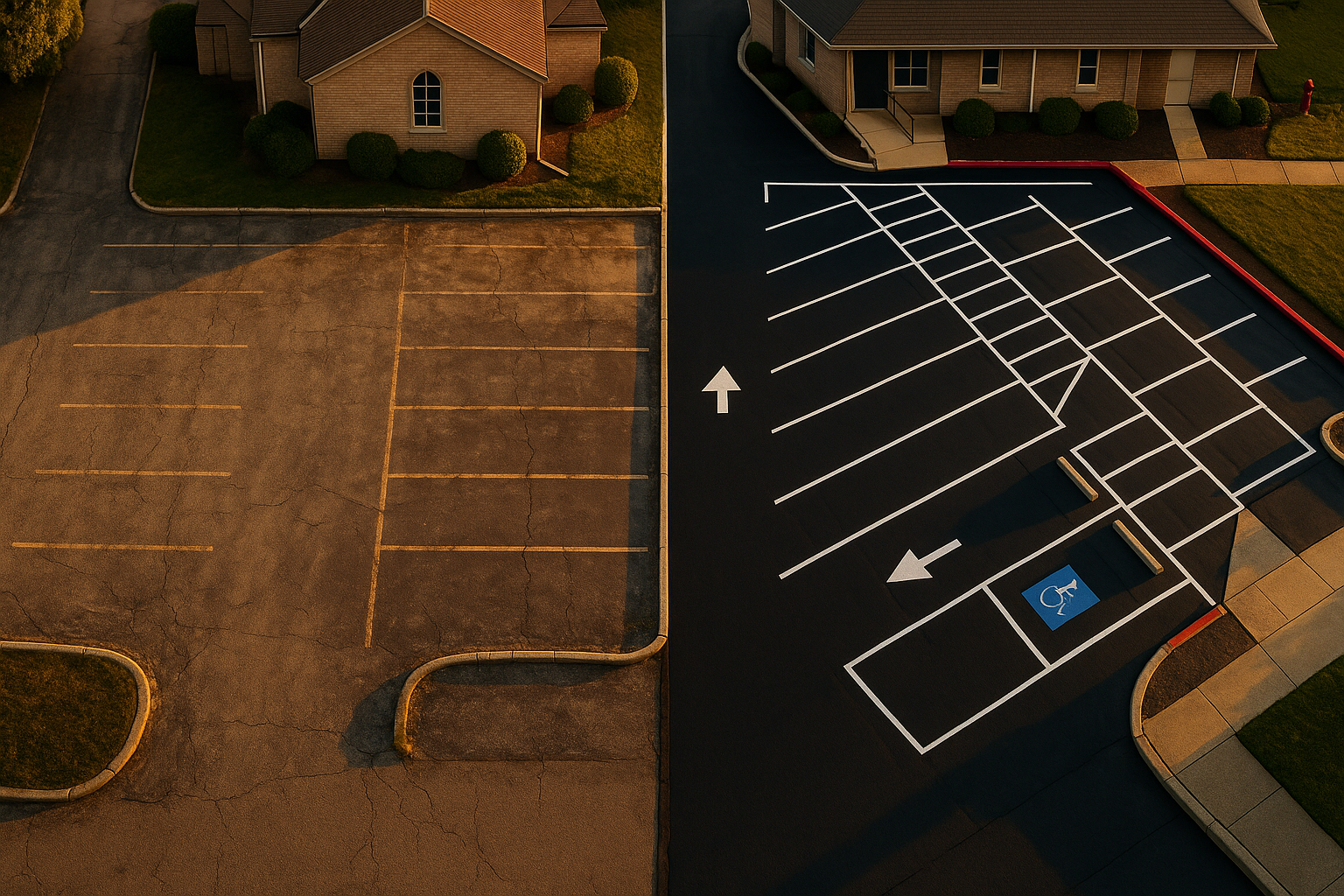
I still remember the call from a church administrator up in Fishers. Every Sunday, it was the same story—cars circling, people late to service, tempers flaring in the lot. The pavement was fine, plenty of asphalt, but the layout? A mess of faded lines and wasted inches. They figured they’d need an expensive expansion, but a simple restripe parking lot more spaces move changed everything. We added 22 stalls without touching a blade of grass. That’s the power of a smart layout, and it’s something most lots in Indy could use.
Your Lot Has More Room Than You Think
Most parking lots aren’t full—they’re just poorly arranged. The first step isn’t painting; it’s measuring. Grab a tape and check your actual curb-to-curb widths. You’ll often find that stalls are wider than they need to be. Around Indianapolis, codes usually let you go down to 8.5 or 9 feet for standard spaces, but lots from the ’80s and ’90s might be striped at 10 feet. Shaving just six inches per stall adds up. A 50-stall row suddenly gains three or four new spots. I did a quick project at an apartment complex in Greenwood where we right-sized the stalls and picked up 10 additional spaces—just by following current local standards, not old habits.
And if you’ve got a section that mostly handles employees or residents who drive smaller cars, you can designate compact stalls. No, they’re not just a California thing. Marion County and most suburbs (Carmel, Fishers, Noblesville) don’t ban them on private lots. You just mark them clearly. That Fishers church? We tucked a row of compacts near the dumpster enclosure, and those fill perfectly with sedans and hatchbacks, freeing up the wider spots for SUVs and minivans.
The point is, you don’t always need to increase your parking capacity without paving more land. A careful layout audit and a few tweaks with the striper can maximize parking spaces without the cost and mess of new asphalt. For property managers and owners, this kind of parking lot layout design reconfiguration is the low-hanging fruit of lot efficiency.
Angles, Aisles, and Flow: The Geometry of More Parking
Straight-in, 90-degree parking feels natural, but it’s not always the smartest use of a tight lot. If you’ve got a narrow drive aisle or an odd-shaped piece of pavement, angled parking—think 45 or 60 degrees—can be a game-changer. Cars slide in and out easier, and you can often fit more stalls along the same curb length. I once helped a small medical office in Zionsville switch from 90-degree to 60-degree angled parking. We gained six stalls and the nurses said the morning rush felt less frantic because the one-way aisle kept traffic moving in a simple loop.
The trade-off is that angled parking works best with one-way aisles. And those aisles can be skinnier than the two-way kind. Local standards around Indy usually let one-way aisles go as narrow as 18 feet, while two-way needs at least 24 feet. That extra 6 feet per row is real estate you can turn into actual parking. But you’ve got to think about traffic flow. Adding directional arrows and stop bars is cheap insurance against confusion. At that Zionsville office, we painted bold arrows and a couple of yield markers, and the flow just clicked.
When you reconfigure a parking layout, you’re not just getting more spaces—you’re often improving safety and driver experience. That’s a win for any commercial parking lot Indianapolis has, whether it’s a strip mall or a church.
Staying Compliant and Safe: ADA, Fire Lanes, and Local Codes
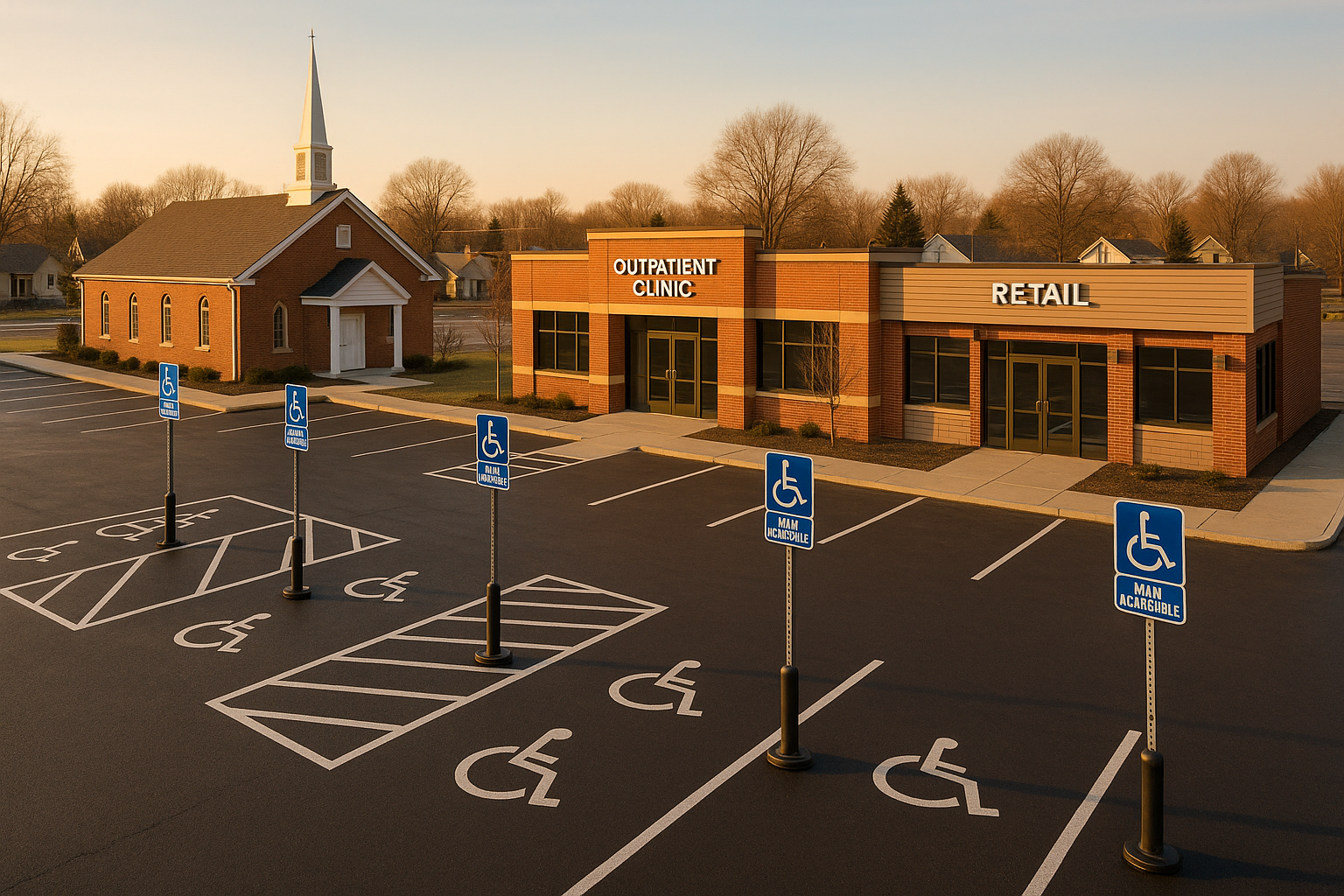
Here’s where people get nervous. “Can I really move things around without getting fined?” Yes, but you have to be intentional. ADA parking layout requirements don’t disappear just because you want more stalls. But you can reposition the accessible spaces to a smarter spot. The law says they need to be closest to an accessible entrance, with the right access aisle width and a flat slope. If your current ADA stalls are in a far corner (I’ve seen this on older lots in Broad Ripple), you can relocate them and actually free up premium spots for general use while staying compliant.
Fire lane striping requirements are another non-negotiable. Those red curbs and zones need to stay clear, and you can’t block hydrant access. But often, the space between the fire lane and the building is dead zone; you might squeeze a motorcycle or bicycle rack there instead. I’ve worked with a few churches up in Westfield that had oversized fire access roads—trimming those back to the minimum code width (while keeping the fire marshal happy) gave them room for a whole row of senior parking. If you want to dive deeper into fire lane specifics, we’ve got a post on fire lane striping that walks through the details.
Every town has its quirks. Marion County parking considerations sometimes differ from those in Avon or Plainfield. In some areas, you need a permit or site plan review for layout changes, even on private lots. PavementPros stays on top of these local rules so you don’t have to. We’ve learned that a quick call to the local building department can save headaches. For example, a lot in Brownsburg we restriped needed a simple stamped drawing because the planners wanted to confirm aisle widths. No big deal—it just took an extra day.
The Indiana Twist: Weather, Snow, and a Timely Makeover
We don’t live in Southern California. Snowplows, salt, and freeze–thaw cycles chew up parking lot markings like nothing else. A fresh striping job in July can look faded by March if you don’t use the right materials. That’s why we spec high-visibility waterborne traffic paint with a heavy mil thickness, and add glass beads for nighttime reflectivity. For lots that get plowed aggressively, we can use a snowplow resistant striping paint that bonds deeper into the asphalt. It costs a bit more, but you won’t be repainting every spring.
Timing matters too. The ideal window in central Indiana is late spring through early fall—dry, warm, and not so humid that paint takes forever to cure. But we’ve got tricks for the edges of the season. Fast-dry traffic paint can be applied in cooler temps and still cure quickly, so you can often restripe in April or October without shutting down the lot for long. Last year, we did a church lot in Noblesville right after Easter, using fast-dry paint, and it was open for the Sunday crowd with zero issues.
A common question: should you restripe before or after sealcoating? You want to sealcoat first, let it cure, then stripe. Fresh sealcoat gives a smooth, dark canvas that makes the lines pop. If you stripe first, the sealcoat will cover them up. We’ve got a whole post on sealcoating timing that breaks it down.
Snowplow damage is real. You can’t stop the plow, but you can plan for it. We always mark out push zones so the snow piles up on grass or gravel, not on your fresh arrows and stop bars. I’ve seen lots where they just stripe right up to the edge, and the first plow pass peels the paint. A little foresight saves a lot of money.
What You Get When You Work with PavementPros
We’re not about showing up with a can of spray paint and a prayer. When you call us about a restripe parking lot more spaces project, here’s what happens: we visit your lot, take laser measurements, and draw up a current layout. Then we model a few options—maybe one that right-sizes stalls, one that introduces angled parking, one that moves ADA spots. You’ll see before-and-after stall counts, so you know exactly what you’re gaining.
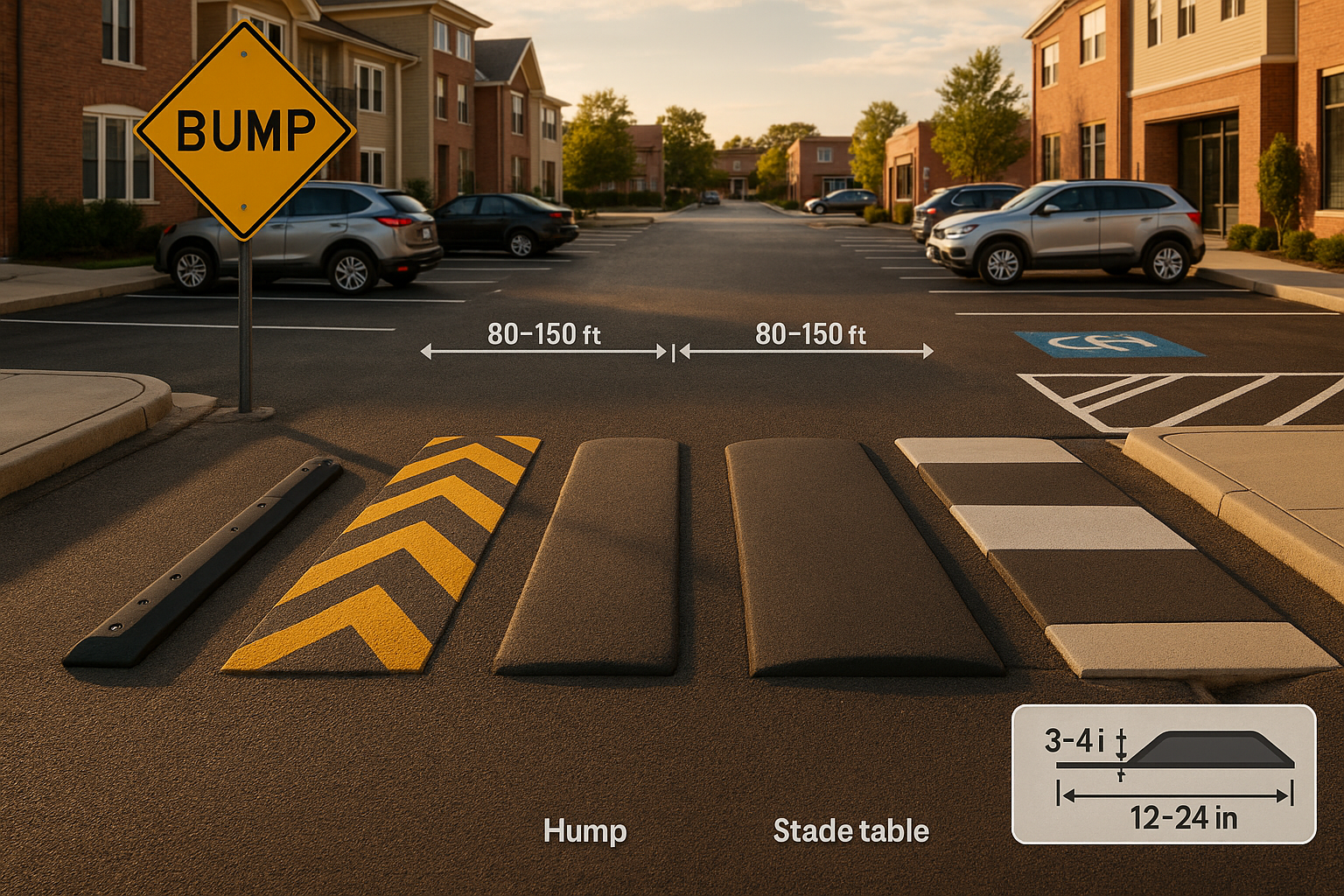
We also check for wheel stops that need repair or removal (here’s a guide on wheel stops if you’re curious), patch up any trip hazards, and make sure all signage is up to code. If your lot is part of a busy retail center along the 465 corridor, we can phase the work overnight so you don’t lose a single sale. Medical offices? We’ve done Sunday mornings. Apartment communities? We’ll coordinate with property managers to keep access open.
The whole point is to give you a clear, compliant, durable layout that actually works for Indiana winters and whatever your lot throws at it. If you’re tired of tenant complaints or Sunday morning traffic jams, let’s talk. Hit our quote form and we’ll come out for a no-pressure assessment. We’ll measure, plan, and show you the numbers. Then you decide. Easy as that.
Ready for a free lot assessment?
We walk the lot, photograph the problems, and hand you a written plan — no pressure, no obligation.