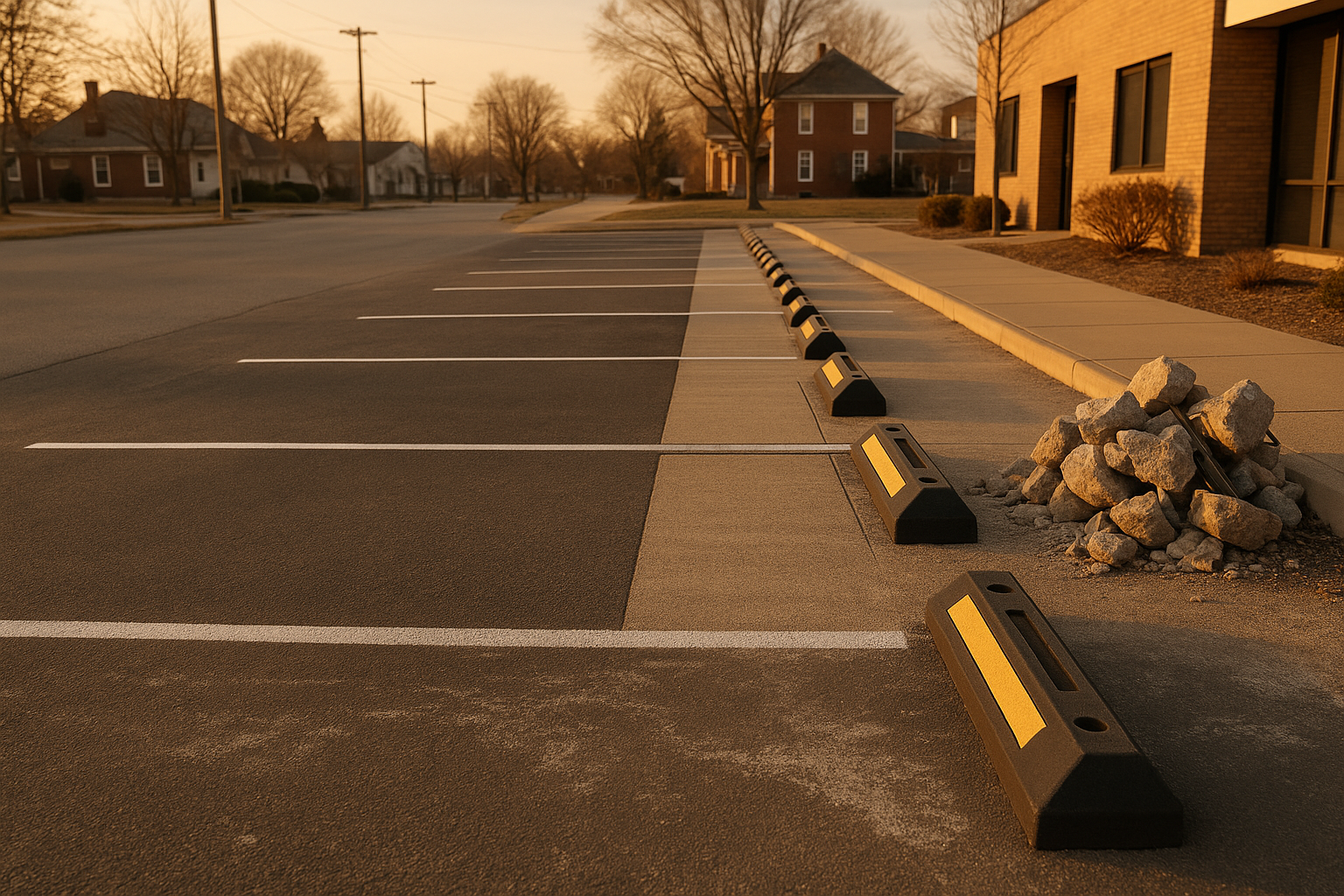
Last winter, I got a call from a property manager down in Greenwood. A snowplow had clipped one of those old concrete wheel stops in his lot and sent it skidding across three parking spots. It cracked the asphalt, tore out the anchors, and left a mess that nobody wanted to park near. He needed it fixed fast—and he needed to know it wouldn't happen again next plow season. That's the kind of headache wheel stop replacement in Indianapolis can solve before it turns into a liability.
At PavementPros, we replace damaged wheel stops and install new ones across Indianapolis and all the nearby communities—Carmel, Fishers, Zionsville, Westfield, Noblesville, Greenwood, Brownsburg, Avon, Plainfield. Whether you're dealing with cracked concrete, missing rubber blocks, or misaligned stops that are more tripping hazard than parking guide, we handle the whole process from tear-out to final sweep.
When Does Your Lot Need Wheel Stop Replacement?
Wheel stops don't last forever. Indiana's freeze-thaw cycles work like a jackhammer, popping anchors loose and cracking concrete. Then snowplows come through and finish the job—busting stops into chunks or shoving them out of line. If you see leaning stops, exposed rebar, crumbled edges, or stretches where stops are just gone, it's time to act. Not just for looks. Loose stops become trip hazards for anyone walking to their car, especially in low-light winter months. And an ADA inspector isn't going to smile at a parking stop that's crept into the accessible route.
Sometimes the problem goes deeper than the stop itself. If the asphalt around the anchor points is crumbling, you might need surface repair before you can set new stops securely. We've seen lots where a fresh sealcoat was needed first to stop the base from deteriorating further. If you're on the fence about sealcoating, we've got a straight-up comparison over on our blog about sealcoating vs. doing nothing—no scare tactics, just the facts.
Picking the Right Material: Rubber or Concrete?
We get this question all the time. Concrete wheel stops have been around forever—they're heavy, cheap, and get the job done. But in Indianapolis, they're also brittle. Freeze water inside a hairline crack, and you've got a split stop by spring. Snowplows catch their edges, and before you know it, you've got a row of tilted chunks. That's why we often steer people toward recycled rubber wheel stops.
Rubber parking blocks Indianapolis take a hit and bounce back. They're lighter, so installation is faster, and they're less likely to damage a car bumper if someone misjudges. Most come with reflective tape molded in, which is a big plus for dimly lit lots in Broad Ripple or Fountain Square. They also resist road salt and de-icing chemicals better than concrete. The environmental angle is nice too—recycled rubber keeps old tires out of the dump.
Now, concrete still has its place. If you're running a truck depot or a spot with constant heavy-vehicle traffic, the sheer mass of concrete might be what you need. But for most HOAs, churches, retail strips, and multifamily properties around here, rubber is the smarter call. We've installed thousands of them, and they hold up beautifully through our winters. Just ask the church in Noblesville that switched to rubber after losing three concrete stops in one season. Zero damage the next year.
How a Wheel Stop Replacement Job Comes Together
Nobody wants a messy, dragged-out project. That's why we start with a walk-through. We'll check your stall dimensions, ADA paths, and drainage—no guesswork. We look at how the existing stops line up with your striping because nothing looks worse than a crooked row of new stops next to faded lines. If it makes sense, we can also refresh your striping while we're there so everything matches.
Once we've got a plan, we set a schedule that works around your busiest hours. For retail lots or offices, we can work after closing or on weekends. For HOAs, we phase the work so residents always have places to park.
Removal comes first. Our crew pulls out the old stops and grinds down or cuts away old anchor pins. On asphalt, we patch the pin holes so water doesn't sneak in and start a pothole. On concrete, we fill and smooth the spots so the surface is flush.
Anchoring is next, and this is where things matter. In asphalt, we drive heavy-gauge rebar pins through the stop into fresh pilot holes. In concrete, we drill and set epoxy anchors that grab like iron. We use corrosion-resistant hardware because road salt will eat cheap steel for breakfast. The depth and placement follow manufacturer specs so the stop stays put even when a plow nudges it.
Then we position each stop with a consistent setback from the curb and spacing between stalls. Straight lines, even gaps, clean look. If you want reflective strips or high-visibility end caps, we can add those too.
Weather plays a role in timing. We don't install with epoxy if a freeze is coming, and we avoid laying fresh patches in a downpour. Spring and early fall are usually ideal, but we work year-round and adjust materials as needed.
If your lot is due for sealcoating or resurfacing, we coordinate the order. Wheel stops should go in after the surface treatment has cured—usually a day or two. We wrote a post on sealcoat frequency for commercial lots that explains typical timelines if you're curious. (It's not rocket science, but it helps to know what to expect.)
Stuff People Ask Us All the Time
A big worry is always: will you shut my parking lot down for a whole day? We get it—closed stalls mean lost sales or grumpy residents. That's why we phase the work and often wrap up a section in a couple of hours. If we're using epoxy, we might have to cone off a spot until it cures, but that's usually 2–4 hours tops. For asphalt pins, the space is ready as soon as we clean up.
Another fear is that the new stops themselves will become trip hazards, especially near the sidewalk. We pay close attention to accessible paths. ADA compliant wheel stops are set back far enough that a walker or wheelchair can pass behind without bumping into anything. We also avoid putting stops where they might catch a toe.
If you've got a large lot with a certain color or style, we can match it. Most rubber stops come in a standard gray or black, but we can order white ones for higher contrast. If you're replacing just a few, we'll match the rest so you don't have a patchwork look.
Snowplows on your mind? If plows are your main threat, rubber stops with deep-set anchors are your best defense. We often recommend setting them a couple inches further back from the plow's turning path if possible. And using epoxy anchors in concrete prevents the wiggle that eventually works stops loose.
We know you're watching costs. That's why we put together a clear, line-by-line scope of work before we ever pick up a tool. No hidden fees, no surprises. The price depends on the number of stops, the material, the surface condition, and how much prep is needed. We'll give you a number and a timetable, and you can decide what fits.
Got a sealcoating or restriping project coming up? We can tie our part to theirs, or at least sequence things so you don't pay for work that gets wrecked. We've worked alongside striping crews and paving contractors all over town, so we can slide right into the schedule.
Yes, we haul away the old stops and metal. You won't have a pile of concrete chunks sitting by the dumpster.
We're no stranger to HOAs and apartment complexes. We've done several HOA parking lot repairs in the Indy area, from small condo courts to big communities in Fishers and Westfield. We understand the need for clear communication and a tidy job site.
Once they're in, wheel stops are pretty low-maintenance. Walk the lot after snow season to check for any shifted stops or loose pins. If something moves, a quick re-anchoring usually fixes it. We can do that on a call-back basis.
If you're ready to get those busted wheel stops replaced—or just want a no-pressure look at your lot—give us a shout. We'll come out, walk the property, and hand you a straightforward plan and price. No jargon, no rush. You can book a visit through our quote page, and we'll take it from there.
Whether it's a three-stall strip in Zionsville or a 200-space lot downtown, we treat every job like the details matter—because they do.
Ready for a free lot assessment?
We walk the lot, photograph the problems, and hand you a written plan — no pressure, no obligation.