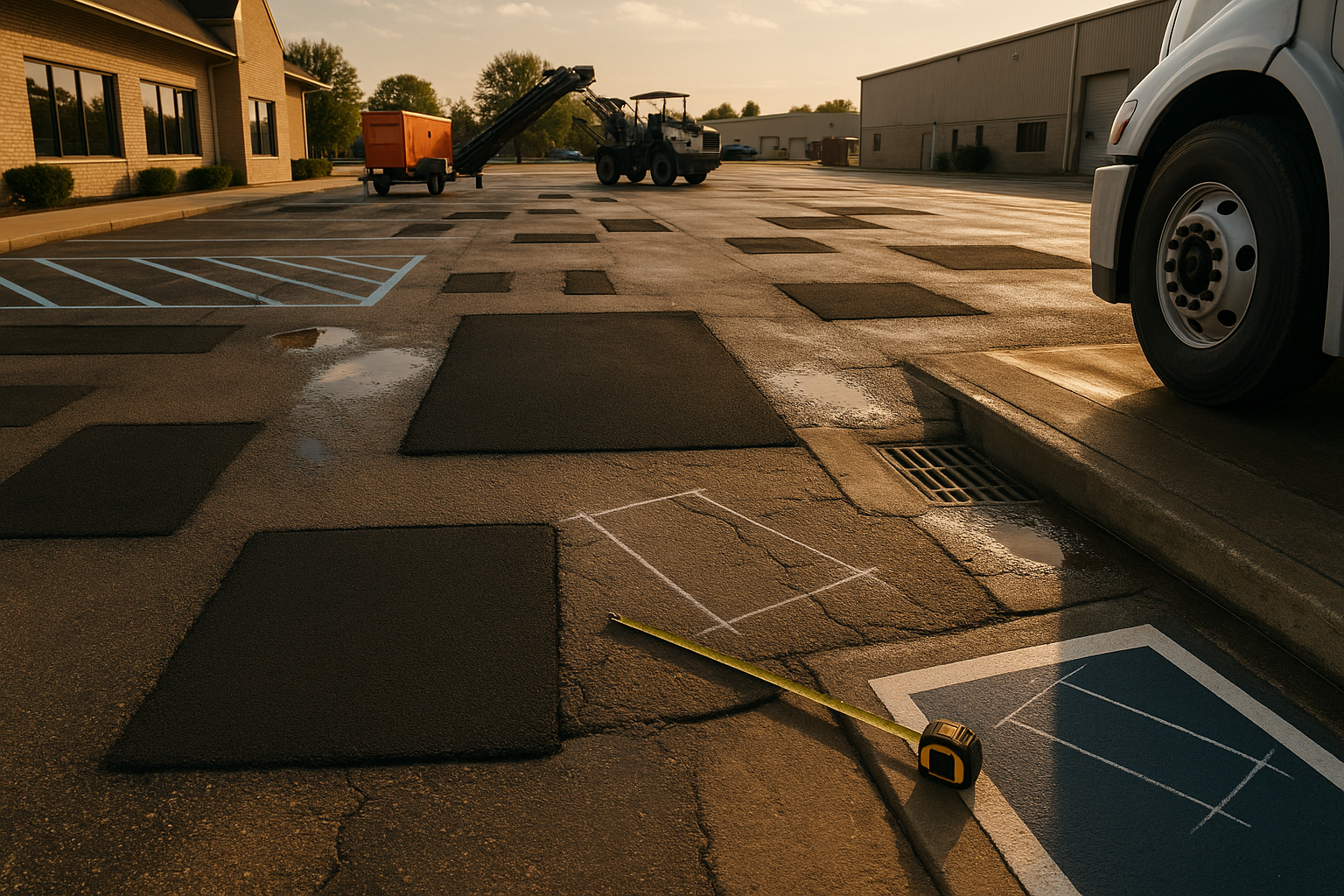
We've all seen it—the pothole that eats your tire on the way into the office. Last winter, a maintenance guy at a warehouse off I-465 called me, exasperated. He'd been dumping cold patch into the same crater every month since January, and it just kept sinking. That's Indiana freeze-thaw for you—cheap fixes don't stand a chance. If you manage a parking lot in Indianapolis or nearby, this guide tells you real asphalt patching prices. It also explains why cold patch is usually a waste and how to get a fix that lasts.
What Drives Asphalt Patching Cost in Indianapolis?
When you call for a quote, a few things decide the price. There's no one-size-fits-all number.
- Size and depth. A tiny skin patch is cheap per square foot. But digging out 8 inches of busted base costs a lot more. Big jobs bring the unit price down. But a single small pothole can cost more per hole because the crew still has to drive to you.
- Base condition. If the gravel underneath is mush—heavy truck traffic near distribution hubs in Plainfield or Greenwood can turn a solid base into soup—you're not patching, you're rebuilding. That's full-depth work.
- Traffic and access. A patch in a tight corner behind a dumpster takes handwork, not machine work. That adds 10–20 percent. Night-only work for a busy drive-thru in Broad Ripple? That's another 10–25 percent.
- Hot-mix season. Indianapolis asphalt plants close when it's cold. Outside April to October, hot-mix is scarce or costs more. Winter jobs often use cold patch as a temporary fix—and you'll pay again when the plants fire up.
- Number of patches. One pothole might be $300. Ten potholes in the same lot? The per-hole price drops when the crew is already there. But you'll still pay a mobilization minimum, often $650–$1,200 for smaller jobs.
Anyone who gives you a price over the phone without seeing the base is just guessing. We need a site visit to give a firm quote.
Typical Asphalt Patching Costs (Indianapolis 2024–2025)
Here are the ranges we usually see. They’re estimates—a site walk gets you a line-item quote.
Skin / Leveling Patch
For shallow flaws, 0.5–1 inch thick overlay. $2.25–$4.50 per sq ft. Good for birdbaths. But this is just cosmetic. If the asphalt underneath is sound, you can buy some time.
Saw-Cut, Remove & Replace (Surface Course)
When the top 2 inches are falling apart but the base is still good. They saw-cut a clean rectangle, dig out 2 inches, put down a sticky tack coat, and lay fresh hot-mix. $8–$12 per sq ft. This is our go-to for cracked spots in shopping center lots.
Full-Depth Structural Patch
If you see alligator cracking or mud pumping out of cracks, that’s base failure. You dig 4–8 inches, pack new gravel, then add asphalt in layers. $12–$22 per sq ft, depending on depth and traffic. A parking spot for a semi needs this.
Infrared Repair
They heat the old asphalt with a machine until it's soft, rake in a little new mix, and roll it smooth. Great for seams and trip hazards. $7–$12 per sq ft. Many jobs have a minimum fee because the equipment is expensive to move.
Pothole Unit Pricing
Small isolated holes: $175–$450 each, based on how big and how many. Combine several in one visit to save money.
Milling & Inlay (Localized)
When the patch has to match the exact height of the pavement around it—like at a loading dock—milling keeps the grade even. $7–$11 per sq ft.
These prices don't include extras like traffic control, weekend surcharges, or putting stripes back after the patch. And if water pools in the area, we might need to extend the patch up to a high point or fix a drain. That's not a hidden fee—it's just doing the job right.
By the way, if you're patching more than 25–30 percent of your lot, it might be smarter to mill and pave the whole thing. A bunch of small patches can cost more per square foot than a full resurface. Check out our crack filling vs. patching vs. repaving guide for more.
How to Pick the Right Asphalt Patch Method
How do you know you need full-depth? Look at the cracks. If you see a spiderweb pattern with loose rocks, and the pavement sinks when you jump on it, the base is gone. Just patching the top is like frosting a cake that's already collapsed.
We once worked in Zionsville for a property manager who insisted on skin patches for a dumpster pad. Every winter, it heaved six inches. Six months later, the patch was a mess. A full-depth fix cost four times more but lasted eight years and counting. That's the real math.
For tight spaces near building edges or utility covers (there are lots in older areas like Irvington), infrared is a smart pick. It bonds the patch so tightly that water can't sneak in and freeze. That matters when we get the January thaws and refreezes we all know.
Water is the enemy. Every patch should push water off, not hold it. That means adding a slight hump and tying into drains. If your lot ponds in a corner off Meridian Street, just patching the low spot won't stop the puddle. We usually saw-cut to the nearest high point, which might make the patch bigger than the hole, but it's the right way.
For commercial lots near the airport or along the 465 loop, heavy trucks mean thicker lifts and more rolling. That's not extra—it's what keeps the patch alive when the first semi runs over it.
And if your patch messes up a handicap stall or an access aisle, you'll need to re-stripe it. It's not just nice—it's the law. See our ADA parking guide.
Why You Can't Just Cold Patch Everything
I get it—a $15 bag from the store looks like a deal. But cold patch is a temporary fix. It never gets as hard as hot-mix, and by March the frost will push it out of the hole. We use cold patch in winter emergencies, but we schedule a hot-mix repair for spring.
The color difference? A new hot patch looks dark at first, but after a few months it fades to match. Infrared blends the best day one, but it costs more.
Ask any good contractor about a warranty. They'll give you a workmanship guarantee in writing—often one year. It covers sinking or crumbling. Plow blades and jackknifing semis are not included. Always get it on paper.
And that mobilization minimum—small jobs still eat up half a day. $650 to $1,200 for a half-day is normal around here. Clump your repairs together to save.
Ready for a Real Quote? Let's Walk the Site
The best next step is a site visit. We'll come out, measure your patches, check the base, and draw a map with sizes, depths, and a clear price for each patch. No surprises. You can upload photos and rough measurements through our quote form or call to set up a 20-minute walk. We'll give you a line-item quote with mix specs and a timeline, whether your lot is in Carmel by the arts district or a warehouse row in Greenwood.
No hard sell. Just asphalt that stays put through Indiana's wild weather.
Ready for a free lot assessment?
We walk the lot, photograph the problems, and hand you a written plan — no pressure, no obligation.