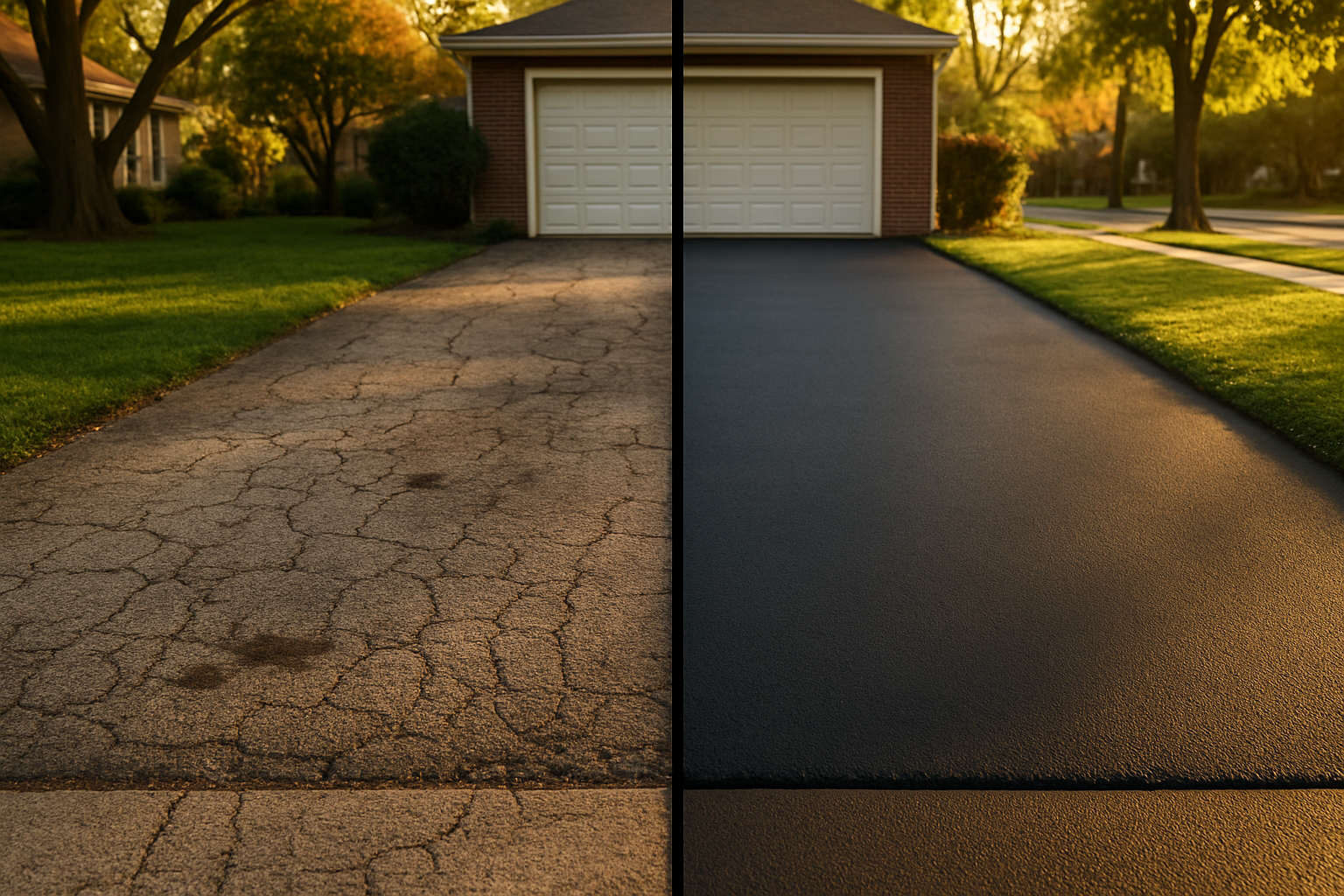
Last spring, my neighbor Jake in Broad Ripple watched a crew sealcoat the driveway across the street. He'd been meaning to get his own blacktop done—it was looking gray and tired—so he called around for quotes. The first number he got was $1,500 for his 2,400 sq ft driveway. The next contractor quoted $800. Same job, same two-coat promise, but a $700 gap. Jake was stumped. Was the expensive guy ripping him off? Or was the cheap guy cutting corners? That’s the puzzle a lot of folks in Indianapolis face when they start Googling "sealcoating cost Indianapolis."
Turns out, sealcoating prices around here aren't as simple as a per-square-foot number. The real cost depends on what shape your asphalt is in, how much prep work it needs, what materials are used, and—honestly—whether the contractor is giving you a full-scope quote or a stripped-down number that’ll leave you with a headache six months later. So let’s break down what you should actually expect to pay in 2026, whether you’re a homeowner in Zionsville, a property manager in Fishers, or an HOA board in Carmel.
What Does Sealcoating Cost in Indianapolis? The Real Numbers
For a residential driveway, you’re typically looking at $0.25 to $0.45 per square foot for two coats. But most companies have minimum charges—often $300 to $600—so a tiny driveway might cost a bit more per square foot than a bigger one. A 2,000 sq ft driveway in Meridian-Kessler? Figure $500 to $900. A 3,000 sq ft driveway in Westfield? Could be $750 to $1,350.
Small commercial lots (think 5,000 to 20,000 sq ft) usually run $0.15 to $0.28 per sq ft. So a 10,000 sq ft medical office lot in Greenwood might be $1,500 to $2,800. Mid-sized lots (20,000 to 200,000 sq ft) drop to $0.10 to $0.22 per sq ft. A 50,000 sq ft retail lot in Avon? Somewhere between $5,000 and $11,000 for the sealcoat itself, not counting prep. Large portfolios (200,000+ sq ft) can dip as low as $0.08 to $0.18.
But here's the thing: those numbers assume the asphalt is in decent shape. The moment you need crack filling, patching, or oil-spot treatment, the price goes up.
The Hidden Costs Nobody Talks About (Prep Work)
I always tell people: the sealcoat is just the pretty part. What really saves your pavement is the prep. And prep is where the cheap bids get sneaky.
Crack sealing alone runs $0.50 to $1.25 per linear foot. If your lot has 300 linear feet of cracks—common after a brutal Indiana winter—that’s an extra $150 to $375. Patching a pothole or alligatored area? $4 to $12 per square foot, depending on depth. Heavy oil spots at restaurant pads? Priming those spots can cost $15 to $40 each, or $0.10 to $0.25 per sq ft of treated area.
A contractor friend of mine told me about a church in Brownsburg that got the low-bid sealcoat without any crack sealing. Six months later, freeze-thaw cycles had already widened those cracks, and the whole thing looked worse than before. They had to pay for crack sealing and a re-seal the next year. That’s why you want a quote that spells out all the prep quantities—not one that just says "sealcoating, $1,800." (If you’re not sure what your pavement really needs, read our breakdown on crack filling vs. patching vs. repaving.)
One Coat or Two? And What’s in That Sealant?
In Indy, two coats is standard. Some contractors offer one coat to look cheaper, but that’s like painting one thin layer on a fence—it won’t last. High-wear lanes (like drive-throughs or bus stops) might need three coats, which adds about $0.03 to $0.06 per sq ft.
The material matters too. You’ll see asphalt emulsion and refined tar-based sealers around here. Both work, but they handle Indiana’s weather a little differently. Tar-based sealers are tougher against gas and oil, but they’re also smellier and some municipalities have restrictions. Emulsion sealers are more eco-friendly and cure faster in humidity. Additives like latex or sand can improve durability and traction—important when winter salt and plows eat at the surface. But adding sand or a premium mix can bump the price by $0.02 to $0.05 per sq ft.
Cheap bids often water down the sealer (or use a thinner mix) to cover more square footage. That’s why a $0.08 per sq ft quote on a small lot might sound great but end up looking faded in a year. (We’ve seen it happen—here’s a comparison of sealcoating vs. doing nothing and why the cheap route costs more in the long run.)
When to Schedule and How Long It’ll Keep You Off the Lot
In Central Indiana, the prime window is late April through September. You want daytime highs between 60° and 90°F and dry weather. Spring storms and surprise summer showers can mess with schedules, but that’s just life here. Fall sealcoating can work, but the cure time stretches out as nights cool down.
After the job, light foot traffic can usually return the same day. But for vehicles, plan on 24 to 72 hours. A sunny, south-facing driveway in Carmel might cure fast; a shaded lot behind a building in Mass Ave could take the full 72 hours. Humidity plays a role too—Indianapolis summers are muggy, so don’t bank on driving across it the morning after. (For more on timing, check out how often you should sealcoat a commercial lot in Indiana’s climate.)
If you’re a property manager, downtime stings. That’s why night work or phased applications are common on busy corridors like Keystone or 86th Street. But expect to pay a premium—5% to 15% extra for labor, lights, and traffic control.
How to Get a Fair Quote (and Avoid the “Too Good to Be True” Numbers)
When you’re comparing quotes, don’t just look at the bottom line. Ask these questions:
- How many coats? (Should be two, minimum.)
- What prep is included? Get linear feet of crack fill and square feet of patching in writing.
- What material and additives? Ask about sand load and dilution.
- What’s the traffic plan? If you need night work or phasing, confirm it’s included.
- Is striping separate? Usually it is, and you’ll want to coordinate it after the sealcoat cures. (Here’s a typical striping cost breakdown.)
To give you a realistic ballpark: a 2,500 sq ft driveway in Greenwood with two coats plus 60 linear feet of crack sealing might run $800 to $1,200. A 50,000 sq ft retail lot in Plainfield with decent prep could be $6,000 to $16,000 all in, depending on patching needs.
And remember, anyone can toss out a per-square-foot number over the phone. But without measuring your site and noting trouble areas, it’s just a guess. That’s why we always start with a measured on-site assessment. You get a written scope with per-sq-ft pricing, prep quantities, coat details, and a firm schedule—no surprises.
So if you’re tired of the guesswork and want a number you can actually budget around, request a site assessment here. We’ll come out to your home, office, or HOA community anywhere in Indianapolis, Carmel, Fishers, Zionsville, Westfield, Noblesville, Greenwood, Brownsburg, Avon, or Plainfield, and give you a plan that makes sense for your pavement—and your wallet.
Ready for a free lot assessment?
We walk the lot, photograph the problems, and hand you a written plan — no pressure, no obligation.